

There are films that unsettle you, and then there are films that make you feel implicated while you watch. Our Hero, Balthazar is the latter. Directed by Oscar Boyson (his feature debut) and written by Oscar and Ricky Camilleri, it’s the kind of movie that sits in a genre category all its own. I am calling them “Doomscroll Thrillers” as these films continue to emerge as one of the most honest subgenres of American filmmaking.
I spoke with Ricky and Oscar about where the film came from, how they built two of the most compelling characters I’ve seen on screen in years, and why they were so deliberate about never telling you what to think.
The film was inspired by a real detail connected to the Uvalde shooting — a young woman in Germany who received an ominous message from the shooter and did nothing. That’s a haunting starting point. How did you go from that real-world moment to the story of Balthazar and Solomon, and how long did it take to get from that kernel of an idea to a finished script?
RICKY: That kernel took a while to pop. We talked about it for a while, the same way we do all our ideas and then one day when it feels ready you start writing. It wasn’t until Oscar added the fake crying that it felt like we could get going. All in all, the process from idea to draft was about a year and then another year to find the money which we kept writing through.
OSCAR: It’s also important to mention, that shooter messaged many, many people. There were a lot of people corresponding with him on various social media platforms. We’ve become so desensitized to “heinous thing someone is talking about on the internet that I can’t do anything about”; you obviously can’t blame a child in another country for not calling the cops in that situation. But the experience of receiving that message felt connected to what its like to grow up with these social media platforms so ingrained in your life. More recently in British Columbia, we know that the shooter was corresponding with Chat GPT and sharing their violent intentions, but the employees at Open AI did not alert authorities, because that would mean actually taking responsibility for something besides stock dividends. That is fatal negligence on Open AI’s part, symptomatic of the same problems, and even more haunting than where we were at when we started writing in 2022.
Were Asa and Jaeden part of your vision from the beginning, or did they come to the project later? Watching them, it’s hard to imagine anyone else in these roles — they disappear into the characters completely.
OSCAR: We try not to write for actors, though it can be hard because you want to have a mental picture of your character and to hear their voice. But, we tried to create an environment where Asa and Jaeden could take over their characters and make them their own, so if we WERE ever imagining anyone else, I can’t even remember who it would have been because those are Asa and Jaeden’s roles now.
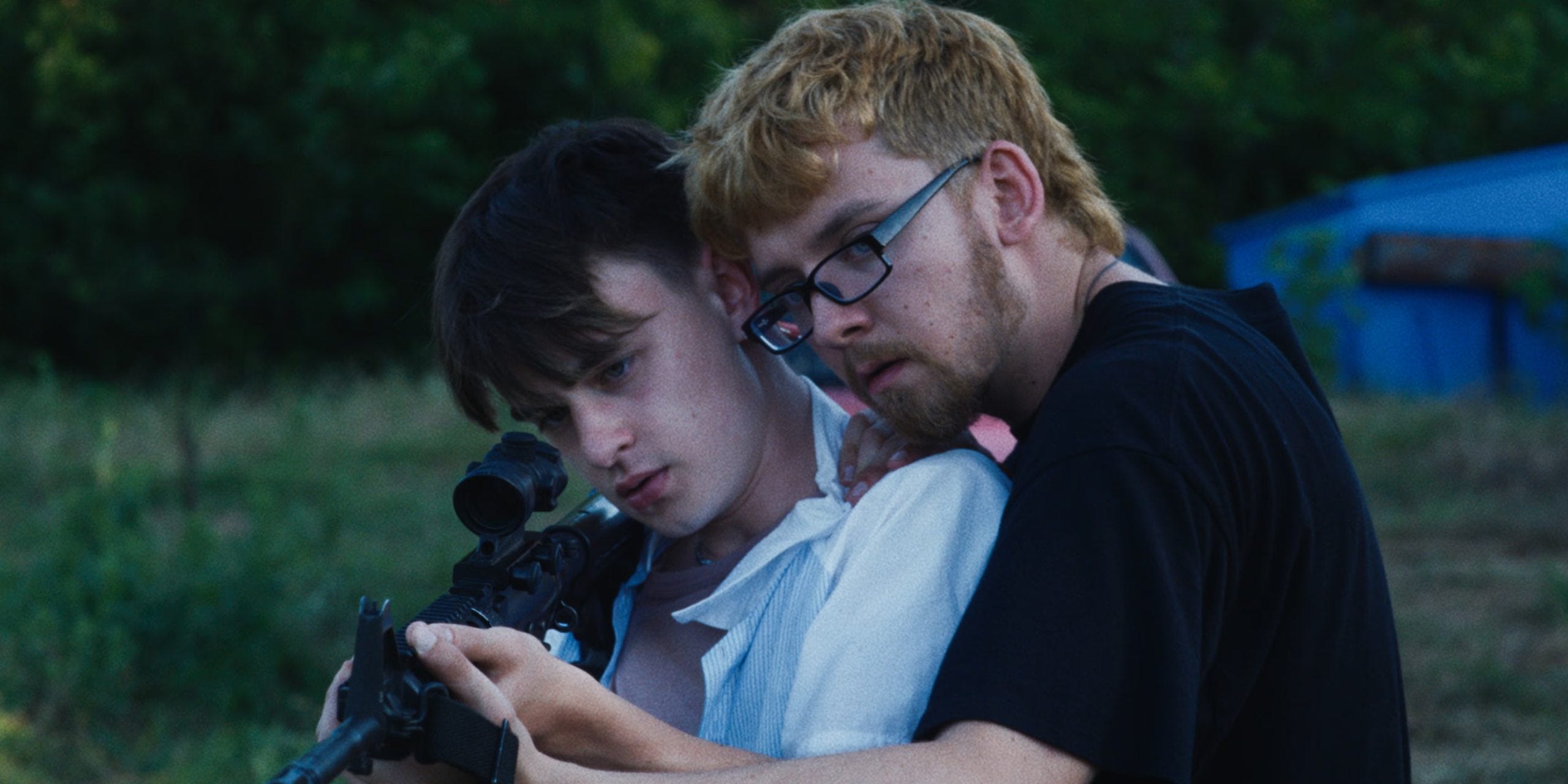
The names Balthazar and Solomon both carry significant biblical and historical weight. Was that intentional, and what did those names mean to you as you built these two characters?
RICKY: The characters have no biblical significance other than in the case of Solomon, it’s possible his father or Mother heard the name spoken in a Christian context of some kind, but most likely never dug into symbolic meaning in the name. Like most Americans, Christian in name only.
OSCAR: I heard the name Balthy once because my former roommate had a friend with that name, and I liked the way it was shortened from balthazar. I never met that Balthy, but I knew that he had a boat that he could take people out in, in Manhattan, so in my head he was a wealthy guy.
Watching it, I kept feeling like the film could go anywhere at any moment — which is genuinely unsettling in the best way. Did you always know where Balthazar and Solomon were headed, or did the ending evolve as you wrote?
OSCAR: The ending always featured the final violent act, but who Solomon was and how we got there changed over time as we continued to discover the character.
RICKY: The fact that the film feels like it could go anywhere and is still entertaining is beautiful to hear. It’s very hard to craft a story that feels accessible and inevitable but not contrived or like you’re going through the beats all others movies do.
The promotional campaign has been really creative — Jaeden staying in character and bringing Balthazar into the real world in real time is a genuinely smart move. Was that always part of the plan, or did it develop organically? And do you think that kind of character-driven, social-native marketing is something more indie films should be doing?
OSCAR: It was always part of the plan, because Balthazar is so online and it felt like a no-brainer not to exploit that. I can’t control how well the movie performs at the box office, but I wouldn’t have been able to forgive myself if we didn’t at least make a splash with our marketing. Especially after so many distributors told us they loved the movie but didn’t know how to market it…that activates the most competitive part of my brain where I’m like “okay I’ll show you.” I’m not sure it makes as much sense for like, a period film where the character doesn’t actually have social media. But for Balthy it allowed us to build intrigue in the character without giving up any of the actual movie, which is exactly what a good campaign should do.
RICKY: This is Oscars department. As an avid hater of social media I was a negative Nancy all the way up until the success of this campaign was obvious. Now I’ve jumped on board like it was my idea from the beginning.
More indie movies should be like our movie in many ways, but then our movie might not stand out of the pack as much - so scratch that.
You have mentioned in other interviews that there is no moral to this story, and you’ve been deliberate about that. But do you think the film has a warning? And if so, who is it directed at?
RICKY: We were deliberate about not being didactic or attempting to present a call to action/solution to gun control, masculinity or any of the other contemporary cancers plaguing modern American life that the movie presents. That said, within our story you’ll find a clear morality on the part of Oscar and I because there were rules set while we were writing such as; we cannot offend parents of victims of gun violence nor should we offend those kids that are truly, sincerely attempting to change the world via their committed and impassioned activism. We do not present ALL the kids as opportunistic activists, nor do we actually show footage, or mock anyone that could be a victim, in fact the movie presents family members of victims such as Supes as deeply wounded whether he’s a snake oil salesman or not and that was to say that everyone in America, no matter their cynicism or venality is touched by this issue. Because at the end of the day it is children being senselessly murdered solely because our policy makers care more about lobbyists and donations than they do our health and safety. There’s a message. Maybe the movie says it, maybe it doesn’t.
OSCAR: I think there is a morality in presenting our sicknesses without flinching, but the least entertaining thing you can ever do is tell people what to do about it or lecture them.
Oscar, this is your feature directorial debut, and it already feels like you have a defined sensibility — kinetic, chaotic, anxiety-inducing in the best way, which makes sense given your producing background on films like Uncut Gems and Good Time. Is that the filmmaking mode you feel most at home in, or is there a completely different genre or tone you’re eager to explore next?
OSCAR: Yeah, it feels true to the movies that I grew up on, which I think in a lot of cases were the same ones that Safdies did. Ricky and I have bunch of completed scripts, all very different. Mostly I’d just like to make another movie, but if I can be picky about it, it will be a completely different genre.
How do you personally categorize this film? I’ve been using the term “Doomscroll Thriller” for movies like this — films that are technically grounded in reality but weaponize social anxiety and human behavior in ways that feel genuinely terrifying. But I’m curious whether you see it that way, or whether genre labels matter to you at all as filmmakers.
RICKY: We knew there was an inherent tension in the “oh Jesus what’s going to happen? It can’t go well” set up of the story, but I don’t feel like I can define the genre of the film. Once we define it as horror or something else, I can’t write.
OSCAR: We tried calling it so many things while pitching it. It was like “if we call it a thriller, are you in?” Looking back, I think it’s a character drama with comedic elements. NOT satire. Satires always feel like they’re bragging about themselves while you’re watching and we tried very hard to not be that.
RICKY: Network, the greatest American movie of all time is excluded from that last sentence.
You’ve talked about wanting to subvert the typical tragedy narrative — where a community suffers and then triumphs. What made that framework feel wrong for this story, and what did you replace it with?
RICKY: I think that framework regarding school shootings in the US is wrong generally. When I watch a movie about how a community healed following a mass shooting I feel like I’m watching propaganda for school shootings. A kind of “these things happen, but don’t worry, you’ll get over it.”
OSCAR: We thought more of the Paul Schrader movies where you’re building to an act of violence or the Tommy Orange book “There, There” where a fabric of societal ills contribute to a powder keg that eventually explodes.
The score uses a one-of-a-kind instrument called the Pandemic Box alongside BABYMETAL as Solomon’s sonic signature. How did sound and music shape the identity of these two characters, and how early in the process did that come together?
OSCAR: Those were both post-production discoveries! Asa and I had a playlist of Solomon’s music, but it wasn’t until after the shoot and I’d had some time to think and dig and chat with one of our EPs, Adrian Simon (who also wrote the theme song for Solomon’s favorite animated series), that I discovered BabyMetal. And shout out to BabyMetal for licensing us the music instead of getting hung up on the movie’s logline, which is what happened with a number of other artists (that will remain nameless) I was interested in licensing. The Pandemic Box, which was designed and performed by Jeff Rosenman in the film, was something our composer James William Blades discovered and just, immediately had our attention. It was like seeing an audition or something and knowing, Mulholland Drive style, “this is the girl.”
You shot scenes all the way through as if they were theater pieces, prioritizing performance over traditional coverage. That’s a bold choice — what did it cost you in the edit, and was it worth it?
OSCAR: I met Matt Dillon a few months before we started shooting, and he was talking working with Lars Von Trier on “The House that Jack Built,” which I think is an incredible performance of his. He was like “I don’t know how they figure it out in the edit, but for us actors its the absolute best way to work” talking about shooting the scene all the way through and sampling from those long takes in the edit versus breaking it into pieces as you shoot. I’ve been working with editors Nate De Young and Erin DeWitt for over 10 years now, and known them even longer than that. We’ve done so many weird and crazy doc and archival projects together, I had no doubt they’d be able to figure it out and what we would gain in performance would be worth it.
Ricky, you come from a live media and interview background — HuffPost Live, Build — where authenticity and performance exist in constant tension. How much did that experience shape the themes of this film?
RICKY: I was working in a live newsroom when Sandy Hook happened and I remember the announcement over the newsroom there’d been a bad school shooting at an elementary school and one of the supervising producers said, “all right, here we go!” And I get it, it was their chance to work hard and prove themselves in the control room, but then you have anchors going on air and presenting this phony sympathetic/objective tone and it all just felt like the presentation of morality without the process of truly feeling it. That one experience always haunted me and I think, although there isn’t a news room in Balthazar that feeling lingers over the entire film.
The film deals with grief narratives, performative empathy, and the attention economy. Do you think audiences are ready to see themselves honestly reflected in Balthazar? Or is that discomfort part of the point?
RICKY: With a film like this, I don’t think Oscar and I can concern ourselves with an audience’s readiness for the subject matter. That would kill the creative process. We focused on the story we wanted to tell and whether we thought it was entertaining enough for an audience to enjoy it.
OSCAR: That’s the thing, people worry too much about what audiences are ready or not ready for. It all depends on how you present the ideas, stories and characters and I hope we presented them in a funny, accessible enough way that whether they were ready or not before, they’re ready now.